

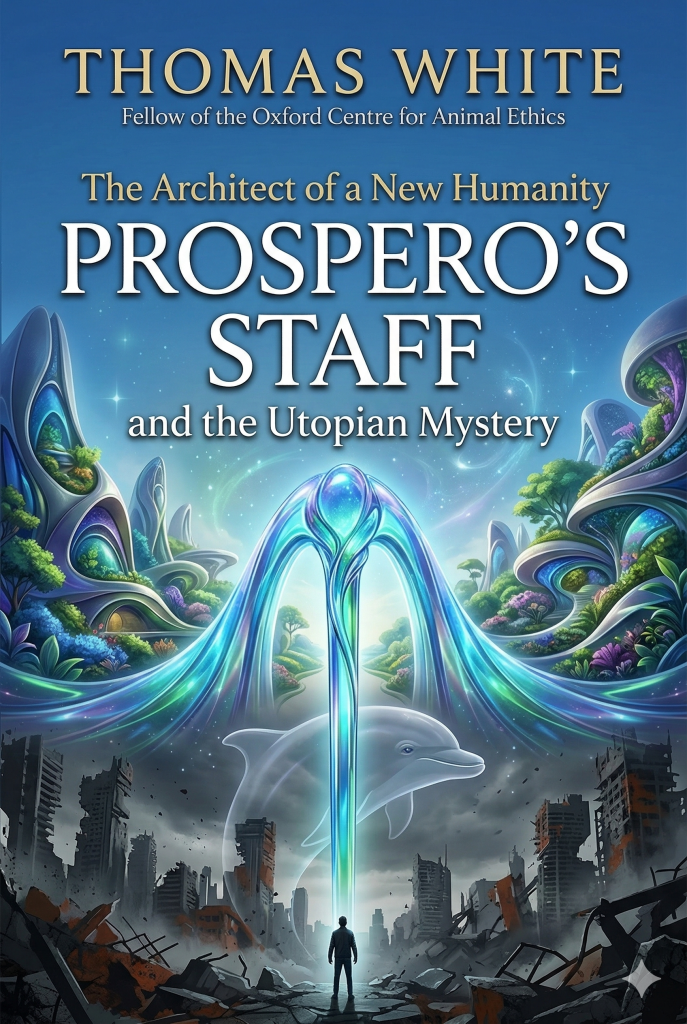
“I’m either a terrorist who hasn’t remembered it yet,” thinks Jane Bradshaw, the time-traveling protagonist of White’s epic, surprising far-future utopian novel, “or I’m on a suicide mission to stop a tragedy of enormous proportions.” That question is one of several tensions powering Prospero’s Staff, which opens with Jane, some 2,000 years after her own time, plunging onto a beach in Nauset—what we once called Cape Cod—with no memory of who she is, how she got there, or why she was sent. Fortunately, the people who discover her prove happy to introduce their peaceful, healthy, tolerant, and egalitarian world to her, despite recognizing her as homo ir—as in homo “irrational”—and linked, by her white skin, to the Azungu, their term for the selfish, primitive, dangerous humans, “the most dangerous of the races of your species.”
As Jane adopts the name of Peregrine, adjusts to the ways of a society that has achieved natural balance, and learns that four Azungu from her past have been sent on a mission to this future that may result in this utopia never having existed at all, Jane faces a hard question: is her mission to protect this society or destroy it? White never shies away from provocative questions as he details—through long but brisk colloquies alive with bold possibilities and striking insights—a future not held back by human greed, digging into food, tech, health, sex, economy, and more, both in Nauset and on a diverse urban island, Atlantis.
Despite the tantalizing mysteries—including excursions into the past that touch on Jane’s life, the Puritans, and Shakespeare—White’s emphasis is on world-building in dialogue form, as Jane learns the many ways that this future society, quite unlike ours, is built for happiness, stability, and fairness, from a no-weapon pact with the whales to choices about how and where to live or what constitutes a family (or pod!), to what it means to “flourish.” This literal future-trip’s blend of philosophy, chatty social critique, and time-travel mystery is unorthodox but thought-provoking.
Takeaway: Utopian time-travel mystery offering much thoughtful surprise.
Comparable Titles: Kim Stanley Robinson; Ada Palmer’s Terra Ignota series.


 ARTIUM: OMNI