

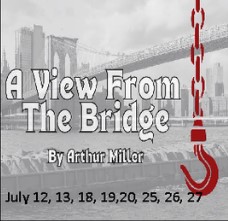
Of the five plays in Modern Classic Theatre Company of Long Island 2025 season, Arthur Miller’s A View from the Bridge has the most claim to the title of a modern classic. Written in 1955, A View from the Bridge is as achingly relevant today as ever in the face of the Trump administration’s anti-immigrant hysteria, and the rising popular opposition to the same. Under the direction of Emily Vaeth, MCT has created an engaging production of this classic, which humanizes the struggle of the American dream, and the conflict between old and new world values.
A View from the Bridge is a domestic tragedy set in Brooklyn in the early 1950s. The play follows the story of Eddie Carbone (played here by Tim Smith), a longshoreman who lives with his wife, Beatrice (Camille Arnone), and their niece, Catherine (Jules Donohue), whom Eddie and Beatrice have raised from an early age. Eddie’s overprotectiveness of his niece is quickly apparent, and it blossoms to unhealthy obsession when Beatrice’s Italian cousins Marco (Andrew Accardi) and Rodolpho (John McGowan), both illegal immigrants, come to live with them, and Catherine and Rodolpho are smitten with one another. Unable to control his jealousy, and unwilling to let Catherine go, Eddie betrays Marco and Rodolpho to immigration officers, and though he ignorance about the raid, his family and neighbors see through his ruse, and shun him for actions that violate the morals of the community. Eddie’s public shaming leads to a confrontation between Marco and Eddie, which culminates in Eddie’s death when, overmatched, he pulls a knife on Marco.
MCT’s production realizes this play in a thrust staging that makes clever use of the BACCA space. The usual seating orientation at BACCA is pivoted for this production so that the downstage edge points towards the doors of the venue, with seats lining both sides of the playing area. A platform walkway encircles the main playing area, while also itself serving as the sidewalk for those scenes set outside, with street lamp posts at the corners, and walls and doorways implied by the staging; a payphone is positioned in the downstage left corner of this walkway.
The Carbone apartment is set on floor level in that encirclement, and the law office of Alfieri (Derek McLaughlin), the play’s narrator, is on a raised platform upstage. This arrangement of the stage, and the supporting scenic design by Ian Fried opens up the space at BACCA, and creates a setting that feels more open than other arrangements I’ve seen there. Dan Kani’s lighting design helps keep these areas isolated to the action, despite some equipment malfunctions in BACCA’s outdated lighting equipment (they would do well to consider some upgrades).
Emily Vaeth’s staging works generally well within this production design: the cast works well with the imaginary perimeters of the space, and she finds creative ways to make their living spaces feel more cramped. Early in the play, when Eddie, Beatrice, and Catherine set the table for dinner, it is a fold out table that is pulled from a perimeter and set up, with seating pulled from different areas of the living space. The cast performs these actions naturally with the dialogue, signaling the regular routines of the cramped living situations of Red Hook’s working poor, even as we learn that this already cramped apartment is about to become more so.
Facilitated by the raised platform upstage, Alfieri is able to oversee the action, and functions as a subtle chorus to it: he is always present, but never draws focus from the story accidentally, which reinforces Alfieri’s role as a bridge between the old world and the new, and literalizes Miller’s metaphor of this story being told from his view. This also serves as a constant, yet subtle reminder that these events have already happened, and their outcomes known. It also forces Eddie into a different, higher space, where Smith makes his struggle to justify his feelings feel authentic: Eddie is out of his element, even as McLaughlin’s Alfieri, clearly a little afraid of Eddie, the fatherly advice that Eddie desperately needs.
Vaeth’s staging does fall into a common pitfall of working in thrust, however: the cast often gets too close to one another, and as they do not take care to line up their opposing shoulders, they block each other from view, cutting off the audience from their action. While this only happens periodically, it tends to be at those most heightened and intimate moments of the play when the cast gets closest to one another: that level of physical proximity tends to work against developing dramatic tension in stage compositions in any circumstance, but in a thrust, it makes it difficult to know what is happening. As engaging as the performances are, it is difficult to stay engaged with them when you can’t see them.
Along with prolonged physical proximity, the cast also often resorts to shouting to reveal heightened emotions, which renders their speech difficult to understand. Yes, their feelings are clear, but the ideas behind them are lost, which I found especially detrimental to Rodolpho’s explanation of his American dream to Catherine. This is a speech that refutes all of Eddie’s rationalizations against their relationship, and most of it was lost on my ears. McLaughlin and Accardi are more restrained in this regard, and their performances of Alfieri and Marco are the stronger for it. The greater problem is that, when everyone has such a hair trigger, it works against the idea that this is a family, and a community, that is trying to get along together, and takes some of the impact away from Eddie’s increasingly erratic behavior, which is otherwise played well by Smith.
That being said, Vaeth has clearly spent a lot of time working with her cast on developing the relationships between these characters, and the ties that bond the Carbone family, and the greater Red Hook community, are clear just and strong. Eddie’s ultimate betrayal of both family and community feels like a breach of trust with us as well. Smith’s physical frame is larger than anyone else in the cast, and he plays Eddie as a man who is used to throwing his weight around, while also seemingly oblivious to the fact that he ever bullied anyone who didn’t want to be overpowered. Smith treats Eddie’s incestuous lust for Catherine like a scotch, indulging in it with hesitation at first, but bingeing on it by the play’s end, when Eddie has at last lost all of the control that he covets to men who seem weaker and less worthy than himself.
Accardi’s Marco and McGowan’s Rodolpho both stand as starkly different contrasts to Smith’s Eddie, which ultimately tells a modern story about the deleteriousness of toxic masculinity to those who embrace it. Though described as a “regular bull,” Accardi is slight in comparison to Smith, but also has a smaller frame than McGowan, which gives Marco’s strength almost a supernatural dimension. Marco is far stronger than Eddie, and both men know it. When Eddie makes the mistake of insulting Rodolpho and Marco’s wife, who is offstage in Italy with, Accardi gives Marco a quiet rage that is restrained only by the love he has for his distant family, and the duty he has to them. But Accardi is also able to show us the passion to take care of his family earlier in the play, choking back tears that Smith’s Eddie regards as a weakness. Accardi is also able to make clear by his presence alone the elder-brother / younger-brother dynamic between Marco and Rodolpho: Marco would never ask his younger brother to take care of his family, and as Accardi plays him, we understand it is beneath his dignity to accept if offered.
Rodolpho has a different kind of American dream than Marco, and McGowan plays him like a man who is madly in love with America for the possibilities it offers. With a charming singing voice, an eye for fashion, and blonde hair that is unique to this world, McGowan gives Rodolpho a sense of good humored enchantment with America, even in the face of Eddie’s bullying. In the face of these aspersions to his masculinity and assaults on his character, McGowan gives Rodolpho the strength to take it all on the chin (literally) with a smile, and keep focus on his goals. McGowan’s Marco is in the land of opportunity, and he draws his courage from his dreams of returning home a wealthy and important man one day, and we see him taking whatever tastes of that dream that he can.
As Rodolpho represents what is beautiful about the old world, Catherine is what is beautiful about the new, and Donohue infuses her with both a desire to be more than what she is, and a youthful naivete that limits her growth. While Catherine protests that she’s tired of being treated like a baby, Beatrice notes that she needs to stop acting like one, and Donohue makes Catherine’s growth from child-like dotage on her uncle to bride-to-be defying his will a counterpart to Eddie’s downfall. Although Donohue’s performance gives Catherine enough tender care of Eddie that we believe that she would be perfectly happy to take Beatrice’s place, and though Catherine cannot resist Rodolpho’s charms, Donohue gives us an engaging sense of the conflict that Catherine has in considering, for the first time, that there may be a man more important to her than the one who raised her.
Arnone is able to likewise find some subtlety to Beatrice, and especially animated Beatrice’s private moments with Catherine with what felt like an investigation as to whether or not Catherine has been deliberately leading Eddie on, which brought a thoughtful dimension to the women’s story. Satisfied that she is not, Arnone’s Beatrice quickly pivots to encouraging Catherine to stop doing so accidentally, and infuses Beatrice’s attempts to get Catherine set up on her own with the urgency of a woman protecting her husband from himself. Arnone also gave Beatrice’s choice of the disgraced Eddie over Catherine at the end of the play the weight of her love for her husband, and made clear it was not merely duty that drove her to it. Arnone’s Beatrice fully thought she was going to be able to choose Catherine, and though having to make the choice clearly hurts her, Arnone gives Beatrice the moment of revelation that there was never a choice at all.
And yet the production plays things a little too safely with Beatrice. Arnone’s Beatrice is never the scold that Eddie and Catherine seem to think she is, and while that does paint the picture of Catherine’s thoughts as completely under the influence of Eddie, it denies Arnone the opportunity to show us Beatrice pushed to the point of confronting Eddie early on, and turns her discussion about their lack of sexual intimacy into something that is almost mundane. In the scope of the whole play, the choice to refrain from letting Beatrice treat Eddie more shrewishly earlier in the play diminishes her actions later on, and denies her a fuller sense of character growth.
The supporting ensemble does admirably to give voices to the Red Hook neighborhood, especially Louis (Kevin Russo) and Mike (Thaddeus C. Plezia), coworkers of Eddie’s who reinforce that the moral obligation to family, and to neighbors, comes before all else. As Longshoremen who are hired as day laborers, both Louis and Mike are materially harmed by the presence of Marco and Rodolpho: the crime syndicate that brings them over will ensure the pair of illegal immigrants are hired regularly as long as they’re both in debt for their journey, but everyone else has to “scramble” for work. Russo and Plezia explore this complexity in a way that lets us know that, harmed as they are by the presence of illegal immigrant labor, they still believe that Eddie is doing the right thing by his family. When Eddie later breaks this code, it’s their icy expressions that distress him the most: if Eddie has lost them, he has truly lost everyone.
The costumes, by Janine Loesch (who, in the interest of full disclosure, has worked with me in other theatrical endeavors) are the most realized of the production elements. The costumes both help ground the production in its time and place, and to tell the story of these characters. I particularly enjoyed the way that Eddie and Beatrice begin the play with a matching color palette, which pivots to Beatrice matching with Catherine later on. Loesch’s costumes for Rodolpho and Marco are make them stand out from this world in their fashion choices, and give us constant indicators of who they both aspire to be.
I found Vaeth’s fight choreography to be as tightly paced as the tempo of her staging. In a thrust setting, it is more difficult to completely hide a punch that does not land, but Vaeth is able to both move the fight along quickly, so that we do not notice, and also to create distractions from non-combatant ensemble members to pull our attention away from some of the technicalities. The brawl she stages at the play’s conclusion finds ways to pull focus every which way, even in the intimate space of BACCA, which is a feat in itself. My quibble, however, is that it is a neighborhood brawl, and that changes the story significantly from what Miller wrote: in Miller’s text, the only bystander who intervenes is Louis, and that is only when Eddie pulls his knife; the fight is otherwise a fair one between Eddie and Marco. In this staging, however, it seemed like all of the men in the neighborhood were involved, and their motivations were unclear; sometimes picking one side, and sometimes the other. Most crucially, Eddie is, by this point in the play, supposed to be a pariah in his neighborhood, and if his neighbors are willing to fight Marco for him, what does it really mean that he’s an outcast?
The production does make some distracting choices that dislocate the action from its period, and distract from it overall. Beatrice at one point is seen writing in a notebook with an acrylic cover and gold trim, and using a click pen: this is so anachronistic that I assume it was intentional, though I’m not sure how to interpret it. This also goes for the newspapers used throughout the production, which with their smaller size and use of color and photos are clearly contemporary to us, and not the world of the play.
The most egregious of these choices, however, is the extensive use of actual cigarettes: while this is authentic to the period, BACCA is a small space, and the production team has taken insufficient steps to provide air filtering and circulation. Presumably, to be compliant with NYS law, these cigarettes do not contain tobacco; nevertheless the smoke hangs in the air, and while it was merely bothersome to me, other audience members complained of headaches, and sore throats and eyes. I hope that MCT will reconsider using live cigarettes for their final weekend of performances, as it nearly drove me out of the theatre before the end of the first act. I also hope that BACCA will prohibit this kind of smoking in their venue going forward. If we can do without live contact in fight choreography, and live alcohol in the prop drinks, this assault on the audience’s senses is wholly unnecessary.
Truly, A View from the Bridge is a classic of the American theatre, and MCT / BACCA’s production does well in bringing the hopes and tragedies of the working poor to life in this production. Individual performances are emotionally rich without being indulgent, and the company animates the story with the urgency of people trying to make ends meet, be good neighbors, and create a better world for their children. There is real heart in this production, and as heavy handed immigration agents destroy lives in our own communities today, I live in hope that it will serve as a reminder to those who see it that all of our ancestors came from somewhere else; that helping family, however distant, was once regarded as noble by all; and that betraying the trust of neighbors and coworkers to a distant and heavy handed federal government was once so disgraceful a thing to do, the only way to escape the shame of it would be to move far, far away.
MCT / BACCA’s production of A View from the Bridge plays its final weekend of performances beginning on Friday, July 25th, and tickets and more info are available at http://www.modernclassicstheatrecompanyoflongisland.net. It’s a production worth seeing: just be sure to take one of your COVID era respirators with you in case you need it.

 ARTIUM: OMNI